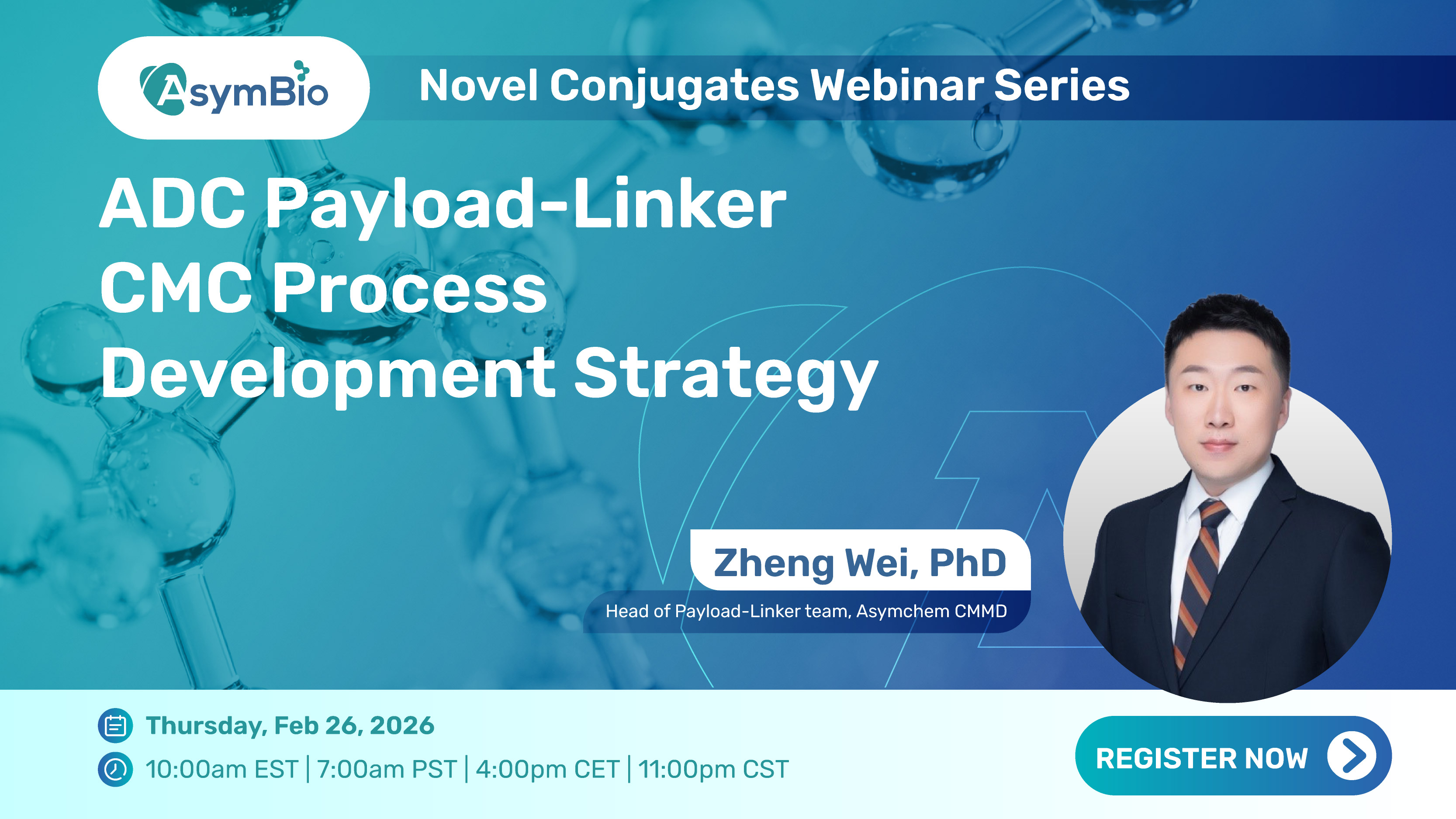
Webinar Overview
With expanding ADC programs and more complex conjugate designs, payload-linker CMC strategy can be decisive for a program’s IND-to-NDA path. As this novel modality continues to develop rapidly, innovative and AI-enabled responsive linkers, highly toxic payloads with low immunogenicity, and site-specific glycoconjugation techniques are receiving increasing attention. In this webinar, Dr. Zheng Wei will share a practical payload-linker CMC development strategy across four areas: guidance and interpretation, route design and principles for regulatory starting material (RSM) selection, stage-appropriate quality control (QC) strategy, and separation/purification process optimization.
The session highlights how payload-linker CMC planning differs between clinical supply and commercial registration, and what drives route definition and RSM designation. An IND versus NDA filing strategy example is used to illustrate stage-appropriate route planning. The session also explains how QC expectations move from release testing and characterization to CQA-linked specifications, with optimization considerations mapped to a typical process flow.
Key takeaways
1. Key guideline statements referenced for payload-linker CMC, and scientifically justified adjustments under technical constraints
2. Route definition and RSM designation strategy for registration planning across clinical and commercial stages
3. Stage-appropriate QC strategy from release testing and characterization to CQA-linked specifications, with impurity-control considerations
4. Optimization considerations across purification, crystallization, lyophilization, ultrafiltration, and nanofiltration
Speaker
Zheng Wei, Ph.D.
Head of Payload-Linker team, Asymchem CMMD